
Payment architecture is rarely reviewed until something breaks
Most leadership teams do not think about their payment architecture on purpose. They think about it when a donor gets charged twice, when a fee calculation comes out wrong on a report a board member is reading, or when a processor account gets flagged and nobody on the team can say why. By that point the review is reactive, and reactive reviews cost more, take longer, and usually surface more problems than the one that triggered them.
The better pattern is to know, ahead of time, exactly where in the payment workflow governance actually matters, who should be watching each point, and what early signals mean the architecture needs a second look before the incident happens. That is what this article walks through.
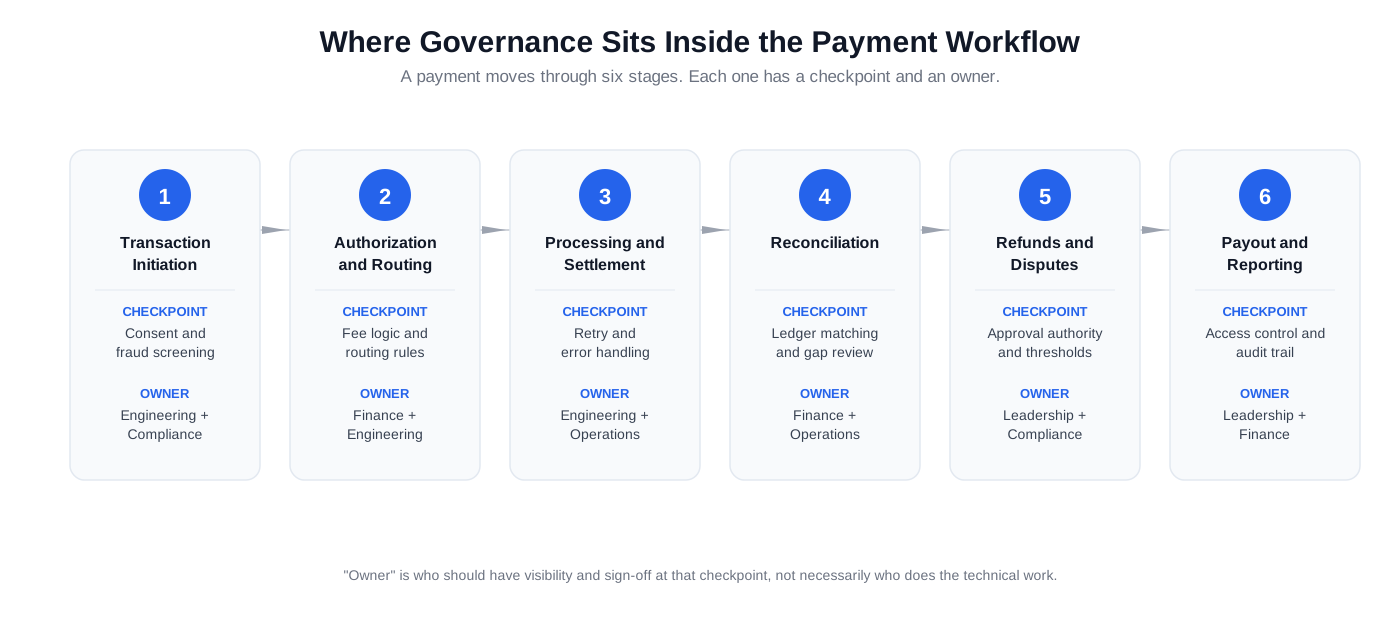
Six places in the workflow where governance actually lives
A payment workflow is not one system. It is a chain of handoffs between your product, a payment processor, connected accounts, your internal ledger, and your reporting layer. Each handoff is a place where something can go quietly wrong, and each one deserves its own checkpoint.
1. Transaction initiation
This is the moment a customer or donor commits to a charge. The governance question here is not "does the checkout work." It is whether the system is capturing consent correctly, applying fraud and velocity checks before the charge fires, and recording enough context that the transaction can be reconstructed later if a dispute comes in. Engineering owns the implementation, but compliance should have a say in what gets checked before a charge is allowed to happen at all.
2. Authorization and routing
Once a transaction is initiated, it has to be routed, priced, and split correctly, especially in marketplace or multi-organization setups using something like Stripe Connect. This is where platform fee logic, currency handling, and connected-account routing rules live. It is also where a lot of quiet bugs hide, because fee logic tends to get written once and then patched repeatedly as edge cases show up. Finance should own the rules. Engineering should own the implementation. Neither should own both without the other checking their work.
3. Processing and settlement
Here the charge actually moves. This stage is where idempotency matters most. What happens if a webhook fires twice? What happens if the processor times out but the charge actually succeeded? Systems that were not built with this in mind tend to produce duplicate charges, orphaned transactions, or silent failures that only show up weeks later when someone reconciles the books. This is squarely an engineering and operations responsibility, but leadership should know whether retry and failure handling was ever explicitly designed, or whether it just happened to work in testing.
4. Reconciliation
This is where your internal ledger gets checked against what the processor actually reports. Reconciliation is often treated as a bookkeeping chore, but it is really a governance control. If reconciliation is manual, growing in hours spent, or catching discrepancies that nobody can fully explain, that is not a finance problem. That is an architecture problem wearing a finance costume.
5. Refunds and disputes
Refund authority is one of the most commonly ungoverned parts of a payment system. Who can approve a refund, at what dollar threshold, and does the system enforce that boundary or just document it in a policy nobody checks? Disputes and chargebacks raise the stakes further, because they carry processor-level consequences if handled inconsistently. This checkpoint needs a clear owner with real authority, not an informal understanding that "someone on the team handles it."
6. Payout and reporting
Money leaving the platform, whether to a vendor, a connected account, or an internal disbursement, is the highest-consequence step in the whole chain. Governance here means verifying account status before funds move, controlling who can view or export financial reporting, and making sure the audit trail is complete enough to answer a hard question from a board member, an auditor, or a regulator without a scramble.
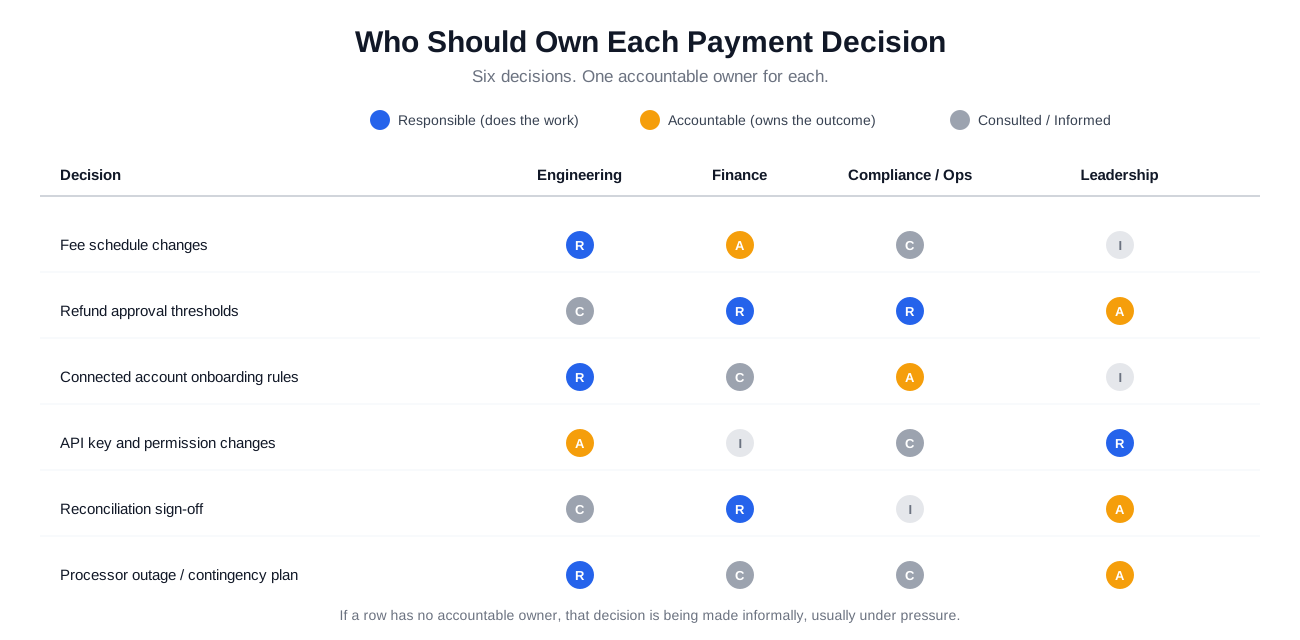
Ownership has to be explicit, not assumed
The chart above is deliberately blunt. Fee schedule changes, refund thresholds, onboarding rules, permission changes, reconciliation sign-off, and processor contingency planning each need exactly one accountable owner. Not a team. Not "whoever notices first." One name.
In practice, most organizations discover during an incident that two people thought the other one owned a decision, or that nobody did. That gap does not show up in a demo. It shows up the first time a refund policy gets challenged, a fee calculation gets questioned by an auditor, or a processor freezes an account and the team has to figure out, live, who is authorized to respond.
The signals that it is time to look
Leadership does not need a payment engineering background to know when it is time to examine the architecture. The signals are usually operational, not technical.
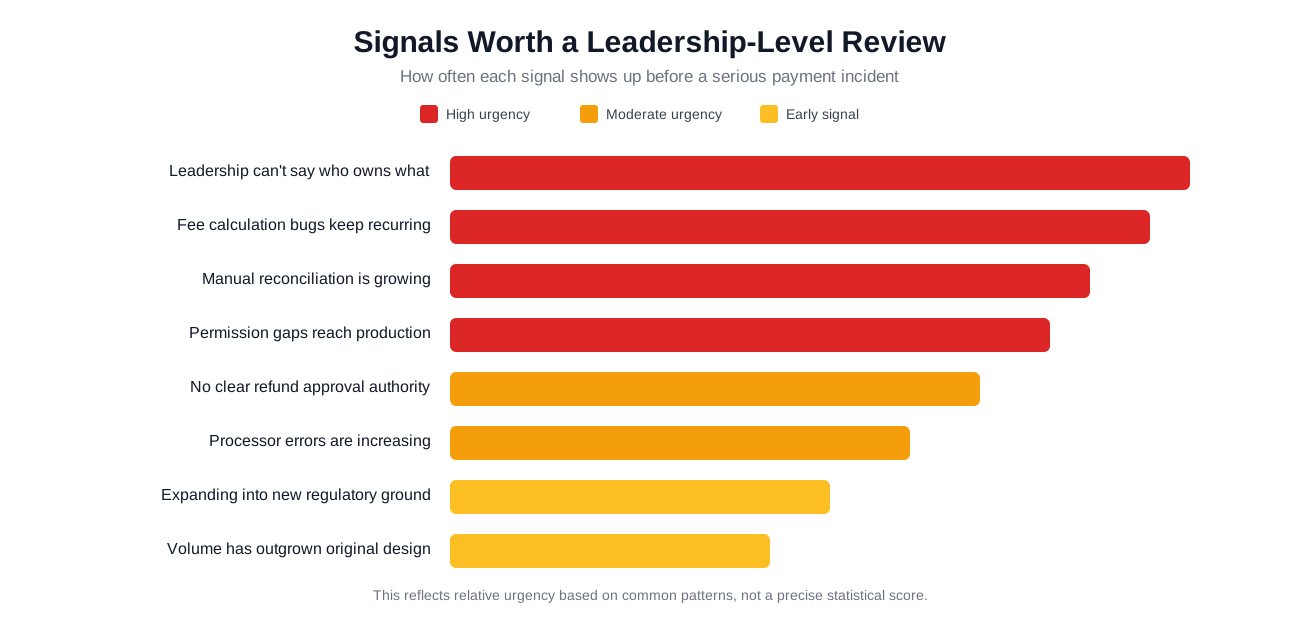
A few of these are worth calling out directly:
- Fee calculation bugs keep recurring. One fee bug is a bug. A second one in a different part of the same logic is a sign the underlying fee architecture was never built to handle the variety of cases it now sees.
- Manual reconciliation is growing, not shrinking. If the hours spent matching records by hand are increasing as volume grows, the system is not scaling with the business. It is falling further behind it.
- Permission gaps reach production. If a role-based error, like the wrong team member being able to trigger a refund or view records they should not, has already happened once in production, it will happen again until the permission model is fixed at the source.
- Nobody can answer who owns refund authority. If this question causes hesitation in a leadership meeting, the policy exists on paper and nowhere else.
- Processor errors are increasing. A rising rate of connected account errors, authorization failures, or platform-level rejections is often the system telling you it has outgrown its original integration pattern.
- The business is expanding into new regulatory ground. New geographies, new donation types, new payment methods, or new connected account structures all raise the bar on what the architecture needs to enforce.
None of these individually means the sky is falling. Together, or repeated, they mean the architecture has not kept pace with what the business is now asking it to do.
What a leadership-level review actually looks for
A useful review does not start with the code. It starts with the workflow, walked stage by stage against the six checkpoints above, asking three questions at each one: who is accountable here, what happens when something goes wrong, and can we prove what happened after the fact.
That last question, the audit trail question, is usually the one that exposes the most. Systems that were built quickly under real deadline pressure tend to handle the happy path well and leave the exception path, the retry, the dispute, the double charge, the permission edge case, thin or undocumented. Leadership rarely finds this by asking "does it work." It gets found by asking "what happens when it doesn't."
The cost of waiting for the incident
Reviewing payment architecture proactively is cheaper than reviewing it during a crisis, and not by a small margin. A proactive review can take its time, involve the right people, and produce a prioritized set of fixes. A reactive review happens under pressure, with a donor or client already upset, a board member already asking questions, and a team already defensive about what went wrong. The technical work in both cases might end up looking similar. The conditions under which it gets done rarely do.
The organizations that handle this well tend to treat payment architecture the way they treat any other system with real financial and reputational consequences: with a defined owner, a scheduled review cadence, and a clear line between what engineering controls, what finance controls, and what requires leadership sign-off before it changes.